MOBILE EXPERIENCE · UX RESEARCH
Tested comprehension and navigation of an activity-based feature for a pre-launch upcoming health & wellness app for a large media company.
ROLE
UX Research Intern · Summer 2026
TIMELINE
5 weeks
METHODS
Semi-Structured Interviews · Affinity Mapping · Synthesis
01 / PROBLEM
This health & wellness product was built around a feature called Actions, which is a loop meant to carry people from reading wellness content to actually doing something about it. Discover an Action, start it, log it, schedule it, save it, share it.
The product and design teams needed to know whether that loop was understandable and felt intuitive before launch. Yet as a researcher, I knew the more interesting question sat underneath it: if people hit friction, where was it actually coming from? Navigation? Unclear buttons? Or a gap between what users assumed "Actions" would do and what the product delivered?
After testing, one clear problem surfaced: users could use this app feature, but failed to explain why it mattered. Their expectations behind what value this app could provide them were consistently wrong or unclear, surfacing feature comprehension and expectation-setting as the largest usability opportunites.
02 / APPROACH
I ran a moderated evaluative study rather than an unmoderated one, because "can they complete the task?" wasn't the real question, but finding out "what do they think this is?" was.
Think-aloud protocol surfaced assumptions in the moment and showed what people expected before they tapped.
Task-based scenarios let me compare success and hesitation across the same points in the journey.
Semi-structured probes opened the room to softer conversations to evaluate usefulness, motivation, whether they'd come back.
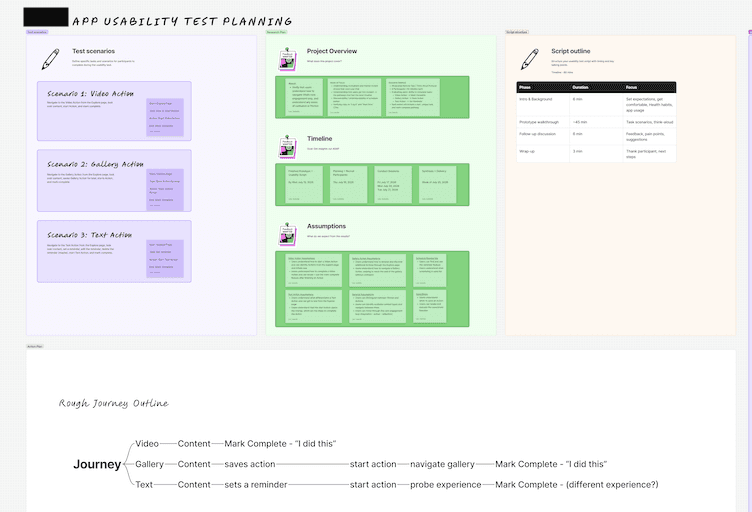
I wrote the research objectives and success criteria in collaboration with Product and Design so findings would align closely to decisions the team was already trying to make.
03 / PROCESS
01 - Scope
Defined objectives, research questions, and what “success” looked like for each task, aligned with Product and Design.
02 - Build
Wrote task scenarios and probing questions designed to catch the gap between expectation and experience.

03 - Moderate
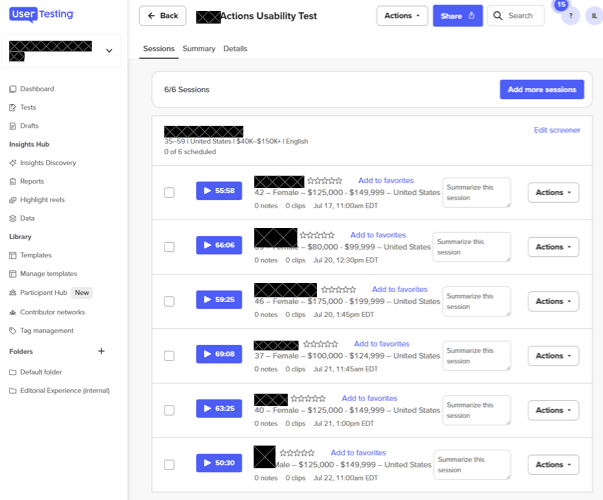
Ran six think-aloud sessions, following confusion when it appeared rather than sticking rigidly to script.
04 - Observe
Logged not just completion, but hesitation, misreading, and the moment someone’s mental model broke.


05 - Synthesize
Affinity mapped across all six participants, then separated usability friction from comprehension friction.

06 - Prioritize
Sorted themes by severity and impact, then translated each into a product opportunity.
04 / ARTIFACTS
See my finished report below!
See my user testing script below!
05 / IMPACT
People could navigate the experience easily. What they couldn't do was explain what Actions were for.
Five findings drove that conclusion:
Users expected Actions to involve interactive and action-oriented participation, not just content consumption.
The logging feature read as a completion signal, but nobody could say why it mattered and how it tied into their wellness journey.
Feature intent was unclear until after tapping. Labels and icons weren't predicting behavior.
Scheduling was useful once found, but hard to interpret on first encounter.
Users expected faster routes back to saved and scheduled content.
The study shifted the opportunity from making the experience easier to navigate to making the purpose and value of Actions easier to understand.
That changed what the team prioritized: expectation-setting in onboarding, clearer feature labeling, and a discussion around about whether some Actions should offer more guided, progress-oriented experiences.
06 / LEARNINGS
1) Task completion is not comprehension. Every participant finished most tasks. Most of them still couldn't tell me what the product was trying to help them do. If I'd only scored success rates, I'd have come to the wrong conclusion.
2) The probing is where the insight lives. The finding didn't come from watching people click through the experience, but it came from asking "what did you expect that to do?".
3) Research is even more valuable when it changes the initial research question. The team came in asking whether the interface worked, and the more valuable answer was actually that the interface wasn't the problem.
What I'd test next: revised onboarding concepts against comprehension measures, alternative labels for primary engagement controls, and whether more action-oriented Action formats create greater perceived value.